SLICE OF LIFE Remembering Roger Ebert and Jane Kleinman
Featured
April 7, 2013

Remembering Roger Ebert and Jane Kleinman

THE TRAIL - BATTERSBY
Featured
March 29, 2013

A Day (and Night) in the Life of Brooklyn’s Most Celebrated Open Kitchen

TALKING SHOP - Author Charlotte Druckman
Featured
October 22, 2012

The First of a Multi-Part Conversation with the Author of the new book Skirt Steak

The View from Chef Dave Mahler's Old Kitchen at La Cusinga (photo courtesy David Mahler)
Featured
September 28, 2012

Guest Poster David Mahler Shares the Story of Getting a Book Done .. . the Hard Way

The Toqueland Interview - Atera's Matthew Lightner
Featured
September 27, 2012

One of Today’s Rising Chefs on Hating High School, the Challenges of an Open Kitchen, and the Meaning of a Dining “Experience”

Charlie Trotter, at his home in Chicago (photo copyright Andrew Friedman)
Featured
August 16, 2012

On the Eve of His Restaurant’s 25th Anniversary (and Imminent Closing), a Conversation with One of America’s Pioneering Chefs

  • SLICE OF LIFE Remembering Roger Ebert and Jane Kleinman
  • THE TRAIL - BATTERSBY
  • TALKING SHOP - Author Charlotte Druckman
  • The View from Chef Dave Mahler's Old Kitchen at La Cusinga (photo courtesy David Mahler)
  • The Toqueland Interview - Atera's Matthew Lightner
  • Charlie Trotter, at his home in Chicago (photo copyright Andrew Friedman)

Toqueland Wire

    Sam Hazen’s Prized La Côte Basque Souvenir

    Just interviewed Sam Hazen of Veritas restaurant for my forthcoming oral history about the American chefs of the 1970s and 80s.  I’ve known Sam since he took over the kitchen at Cascabel restaurant (in the space that is now Osteria Morini) in the mid 1990s, and have flitted in and out of touch with him over the years.

    It was a fun interview: Sam attended the Culinary Institute of America in the early 1980s, and went on to cook at La Côte Basque and the Quilted Giraffe, among other New York restaurants.  When I first walked into Vertias to meet him, he surprised me with a bag of keepsakes from his line-cook days, just for fun. The highlight was this jacket, which Jean-Jacques Rachou (one of the first French chefs to welcome young American cooks into his kitchen in those transitional days), gifted his brigade for Christmas 1983.  When the old gang reunited in 1995 for the shuttering of the restaurant’s original location (it reopened in a nearby home a few months later), Sam asked a number of them to sign the jacket–an all-star line-up that included Rachou himself (“JJ Rachou,” right under the restaurant’s name), Charlie Palmer (just under Sam’s embroidered name), Rick Moonen (under Charlie), and Waldy Malouf (lower right corner).

    Sam Hazen's La Côte Basque jacket


    Sam’s fondness for Rachou and La Côte Basque was plain.  He worked there for five years, an almost unimaginable length of time by today’s standards.  When I remarked on how emotional he seemed when discussing those days, he whipped out his cellphone and showed me that La Côte Basque’s phone number was still in his directory, even though the restaurant has been gone for about a decade.

    “You can’t erase that one,” I said, thinking of my own policy of not deleting the phone numbers of the deceased.

    “No, that one stays forever,” he said.

    We didn’t get through all we had to talk about today and Sam promised to bring some more “fun stuff” to our follow-up interview.  I can’t wait.

    - Andrew

    A New Book Deal and What it Says About Chefs and Restaurants with Literary Aspirations

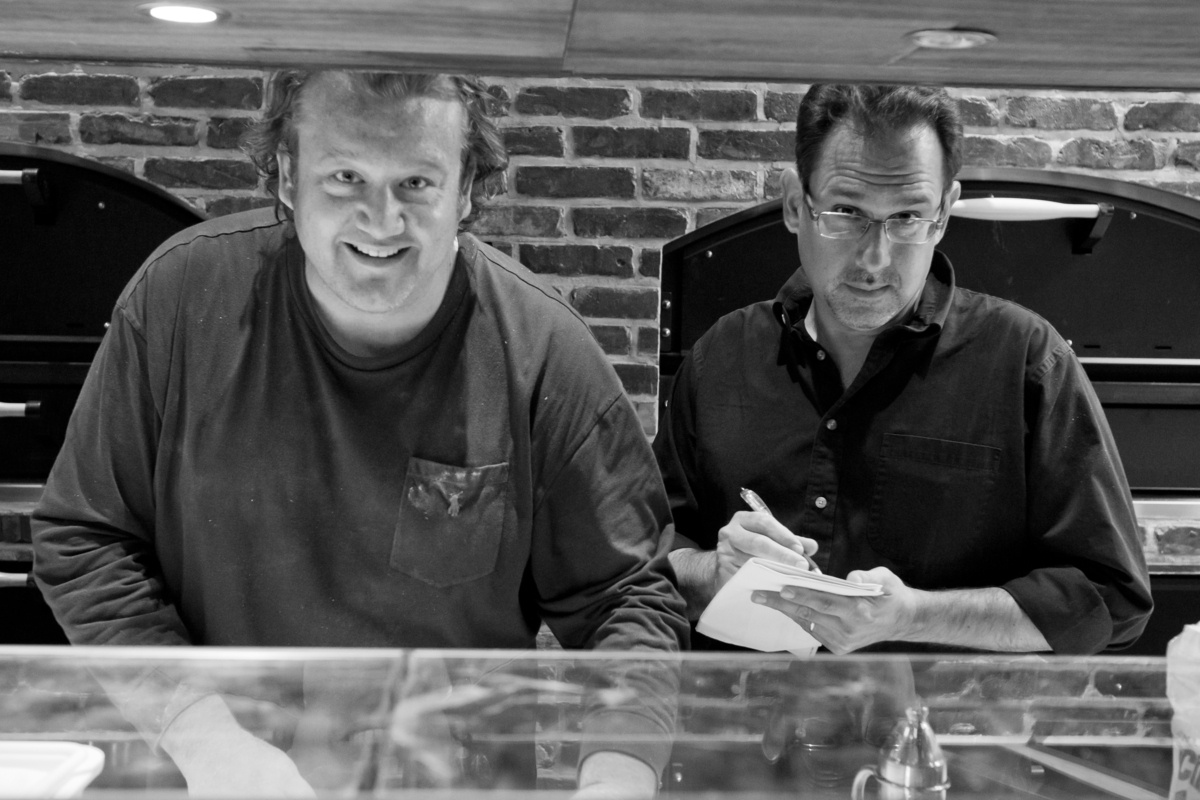
    Chefs Joe Ogrodnek (left) and Walker Stern, in Battersby's Open Kitchen

    I’m delighted to announce that Grand Central Publishing (specifically the imprint Grand Central Life & Style) has picked up the proposal I recently wrote with Battersby chefs Joseph Ogrodnek and Walker Stern.  The book, BATTERSBY: Extraordinary Food from an Ordinary Kitchen, will be published in 2015. (For some backstory on the project, check out this recent piece about a day and night in the Battersby kitchen.)

    Here’s the official Grand Central announcement:

    “Karen Murgolo, VP, Editorial Director of Grand Central Life & Style, has acquired world rights, with Amanda Englander also editing, to the first cookbook by Joe Ogrodnek and Walker Stern (chefs and co-owners of Battersby, the beloved restaurant in Brooklyn’s Cobble Hill neighborhood). Set for publication in 2015 and won in auction, BATTERSBY: Extraordinary Food from an Ordinary Kitchen (written in collaboration with Andrew Friedman) promises to help readers prepare and serve sophisticated, satisfying food, with advice on what to prepare ahead and then how to finish later, a boon for those of us with limited time and space. Represented by David Black of the David Black Agency.”

    (In the small-world department, Grand Central also picked up the other collaboration I’m working on, Harold Dieterle’s Kitchen Notebook.)

    Collaborating on this proposal, and taking it to market, crystallized a few recent evolutions in the process of conceiving and selling books based on chefs and their restaurant work, so I thought I’d share a few impressions along with this news:

    1.  With few exceptions, it can’t be just a restaurant cookbook.  When I first started writing with and about chefs, selling a restaurant cookbook was a layup.  A toque armed with two or more New York Times stars could more or less put forth a proposal for the So-and-So Restaurant Cookbook, load up the resulting tome with photographs of signature dishes (prepared to the restaurant’s exacting standards, with ring molds, countless sub-recipes, and a litany of expensive and hard-to-procure ingredients), and find publishing success.  No longer.  With very few exceptions, chefs who want to write cookbooks need to identify and focus on what I call “the bridge” – an aspect of what they do in their restaurants that ties into what people do at home, and to be willing to strip down and/or simplify their restaurant repertoire in the process.  In the case of Battersby, the book’s focus will be how to cook and serve sophisticated food that isn’t overly complicated and which can largely be prepared in advance, then finished and served with a modicum of time and effort.  The concept grew organically out of how the restaurant functions; the open kitchen is famously cramped, with room for just three cooks, so the guys have had to develop a repertoire of dishes that fit that description. Although the book is titled after the restaurant, it is most definitely not a restaurant cookbook.  The truth is that we couldn’t come up with a different title that summed up the concept and also fit the personalities of the two young, Brooklyn-based chefs in the author seat; in this case the subtitle “Extraordinary Food from an Ordinary Kitchen” (which Joe devised during a meeting with our agent), is as important as the title itself.

    2.  Do proposals need to be visual?  I’m phrasing this one as a question because the jury’s still out, but recent events have caused me to wonder.  When I first started writing for a living, I was stunned to learn that book proposals, even for lavish, coffee-table-scaled books, were presented as simple Word documents, with no photography or graphics whatsoever; they looked so dry and lifeless that I took to calling them “business plans without the numbers.” Recently, though, some friends have had success with art-directed proposals that give a real sense of what the book they have in mind will look and feel like.  We decided to do the same thing with the Battersby proposal, enlisting the help of a talented and exceedingly generous friend to come up with a proposal that brought the words to life with graphics and photography.  How much did this matter in the end?  We’ll never know.  But at a time when selling books is harder and harder, you want to do everything you can to set yourself up for success and when our agent took this thing to market, we definitely felt like we were putting our best foot forward.  Personally, while I could see selling a non-fiction book the old-fashioned way, I can’t see going out with a non-art-directed cookbook proposal again.

    3.  Chefs and photographers. Photographically speaking, the day of the dog-and-pony show is over.  Once upon a time, when a chef (or chefs) sold a cookbook project to a publisher, one of the first ensuing steps was to enlist a photographer, usually by calling in a handful of photographers, who came to meet us with their “books” – outsized portfolios that they walked you through as they discussed how they saw your project.  Today, more often than not, chefs have preexisting relationships with photographers for the simple reason that they spend more time with photographers than they used to .. . where a photo session was once a rare and special thing, chefs are now regularly shot for blogs and food sites, and hire their photographers directly for their own websites and other special projects.  Where a book’s editor and I used to recommend photographers to the chefs, on the last several projects I’ve been involved with, the chefs have come to the table with photographers in mind:  both Paul Liebrandt and Michael White had a relationship with Evan Sung and brought him on board for their books, and Harold Dieterle told me early on he wanted to enlist Daniel Krieger.  The Battersby boys were no different: they were so committed to using Finnish shutterbug Tuukka Koski that we actually put his name in our proposal . .. that was a first for me, but surely not the last time I’ll do it.  As with these other developments, I suspect that the exceptions are fast becoming the norm.

    - Andrew

    Published in Battersby

    Remembering Roger Ebert and Jane Kleinman

    [Regular Toqueland readers will have to forgive me – this post has nothing to do with chefs or restaurants – but I wanted to share these thoughts.]

    Jane Kleinman

    I learned of the death of two people who had a tremendous impact on my life last week: One you’ve heard of and one you probably haven’t.  One I knew personally and one I never met.  Both helped me understand myself a little better when I was a teenager and then, unexpectedly, taught me something about death and dying as an adult.

    The one you probably never heard of was my high school drama teacher Jane Kleinman.  I have no recollection of when I first met her; when I think back at that time in my life, it just seems that she was always there. As a student at Ransom-Everglades school in South Florida, I took her drama classes and acted in her productions, rehearsing on weekday afternoons and performing on Friday and Saturday nights:  Carnival, Our Town, Guys and Dolls – if you were an adolescent thespian, you can probably guess some of the others.  When I directed our senior class play David and Lisa, she flattered me by playing a small role herself.

    Jane’s classroom wasn’t a typical one.  It was a wide, desk-less space and I remember hanging out there before homeroom and during down times between classes. Rehearsals for her plays were the social highlight of my adolescence, along with weekend set-construction sessions, road trips to state acting competitions, post-performance gatherings at the local Swenson’s, and the wrap parties that followed the end of each run.

    Jane was also my first connection to the greater artistic world.  She had studied with some up-and-coming actors of the time, such as Jim Puig, a local talent who had gone on to Broadway success in Rum and Coke, and Steven Bauer, who played Al Pacino’s aide de camp in Scarface, and who was married at the time to Melanie Griffith.  This was the early 1980s and our school was a tony private academy on Biscayne Bay, but it was also situated in Coconut Grove, which retained much of its ramshackle 1970s hippie charm — after school, a bunch of us regularly strolled into the Grove, past palm trees and pink, Spanish-style houses to sit at breezy outdoor cafes and on weekends we’d go to the Grove Cinema and participate in midnight showings of the Rocky Horror Picture Show. Against that backdrop, Jane helped guide my creative awakening, along with the brilliant English teacher Dan Bowden; the big-hearted Beau Siegel, a raspy-voiced New Yorker and art instructor; and another teacher – I’ll leave her nameless here – whom a bunch of us called by the nickname we overheard an adult friend call her one day,  “Doobie,” until she told us we had to stop before we got her fired.  (We didn’t know what it meant!)

    Jane was not a slim or glamorous woman, but she had a beautiful face and a heavenly voice. One year, at the school talent show, she stood on a bare platform illuminated by a harsh spotlight and somewhere between Jenna Robinson’s rendition of “Nothing” (the song about Mr. Karp) from A Chorus Line and Jeremy Haft’s monologue from Feiffer’s People, sang “Send In the Clowns.”  Thirty years later, I can still hear the wistful, Patsy Cline-worthy ghost of a laugh she inserted between “Don’t bother” and “they’re here.” Most of us had never heard her sing before and we were spellbound, as though discovering she possessed some kind of superpower that she’d been hiding from us.

    My most indelible memory of Jane – Ms. Kleinman to me in those days – is the warm-up exercise she engaged us in before each play we put on.  The cast would gather in a circle backstage and hold hands.  We closed our eyes and she’d talk about “the heartbeat,” a pulse that united us and which would ensure that we were in synch on stage.  As she spoke, she squeezed the hand of the person to her left and told that person to pass it on to the next one, and to keep it going until the heartbeat came back around, over and over again.

    And there we stood, eyes closed, waiting for the squeeze on our right hand, then squeezing the hand of the person to our left.  She’d talk us into a trance, describing how we were a unit, how our hearts  beat together, and as she did, she’d direct us to pass the heartbeat along a little faster, and the pulse would make its way around the circle, coming back around almost as soon as it left us. When it seemed to be moving as swiftly as an electron, she’d quietly say, “Break a leg,” and we’d all let go of our hands and open our eyes, a little dizzy from the experience, and go to our respective ready positions for lights up. Expand

    Published in Ruminations, Slice of Life
    April 4, 2013

    The Waiters

    Two Decades Later, a Short Film with a Restaurant Punchline Still Brings the Funny

    The other night, I had dinner at Carbone, one of the biggest openings of the season in New York City. I loved the food at this Mario Carbone-Rich Torrisi paean to Italian-American restaurants, in the former home of Rocco’s on Thompson Street. Early in the experience, while sitting with the skyscraper-sized menu (wish I had a photo) listening to the litany of specials from the tuxedoed waiter, I was reminded of a short film that ends with a deadpan, endless riff on the exact same type of recitation, complete with two (unseen) diners holding similarly gargantuan menus.

    The film, The Waiters, isn’t about restaurants — it’s an extended play on its title, an absurdsit, at times David Lynch-like look at various “waiters” that ends with the restaurant variety (that bit begins at the 5:10 mark).  Enjoy:

    I first saw this movie about 20 years back, when I organized a short-film series at Cascabel restaurant, in the space that is now home to Michael White’s Osteria Morini.  The film was made at NYU, written by Thomas Lennon, who went on to a successful career as a comedic writer and actor, and directed by Ken Webb. Though I hadn’t seen or thought of it in ages, it came right back to me at dinner. Guess it was there in my memory all along, just – er – waiting to be triggered.

    - Andrew

    Published in Depictions, Restaurants, Video
    April 3, 2013

    CIA Catch Up

    Culinary Institute of America President Dr. Tim Ryan Hints at New Courses in Entrepreneurship, Opines on Celebrity Chef Culture 

    CIA President Dr. Tim Ryan (photo courtesy Culinary Institute of America)

    As many Toqueland readers know, I’ve been working on a book about the American chefs and restaurants of the 1970s and 1980s. One of the great pleasures of this project is that it’s given me an opportunity to sit down with some of the most important figures in food, and hear their backstories firsthand.

    It also gives me a chance to check in on new developments which I did when I recently sat down with Dr. Tim Ryan, president of the Culinary Institute of America.  Over the course of about 2 1/2 hours, we had a fascinating and far-ranging conversation that covered everything from how he first got interested in cooking (a legendary Time magazine cover story about Paul Bocuse, whose name now graces the school’s flagship restaurant, had something to do with it) to his role in creating the American Bounty restaurant on the CIA campus, to who his classmates were at “the Culinary” (among them was Susan Feniger, whom Dr. Ryan recalls was easy to spot because she was one of but a handful of women on campus at the time).

    All of that will stay in the vault until the book publishes but when I asked the good doctor if there were any new developments on the horizon at the CIA, he offered up a hint of a new column of courses centered on the business of cooking.  Though he couldn’t divulge the nitty gritty just yet, here’s the relevant snippet of our conversation:

    RYAN: I can’t tell you specifically what we’re doing, but it’ll be big. It’s how we do an even more effective job seating entrepreneurs, because that’s one of the things that starts back in this very era that you talk about [in your book] — chefs as entrepreneurs. And we’ve had great success everywhere from Grant Achatz as an entrepreneur at the highest end to [Chipotle founder] Steve Ells . .. . so how do we help even more people become entrepreneurs and avoid some of the pitfalls?

    TOQUELAND: You’re talking about classes that would be more in line with what people might think of as a traditional MBA-type program, but not exactly that.

    Expand

    March 29, 2013

    THE TRAIL: Battersby

    A Day (and Night) in the Life of Brooklyn’s Most Celebrated Open Kitchen

    Chefs Joe Ogrodnek (left) and Walker Stern, during a break in the action.

    For some time, I’ve had it in my mind to introduce a recurring feature about a day in the life of different restaurants.  The name of this intermittent series, “The Trail,” is the term used to describe a potential employee’s observation of, and sometimes participation in, a day of service at a restaurant where he or she hopes to work.

    Along with a lot of things here at Toqueland, I had to back-burner that concept in deference to a pileup of book deadlines.  But the perfect union of my book and blog lives presented itself recently when I needed to trail at Battersby, the successful Smith Street (Brooklyn) restaurant, for the purposes of a book proposal I’ve been writing with chef-owners Joe Ogrodnek and Walker Stern.

    I normally don’t bother trailing at a restaurant for literary purposes, but in this case, observing happened to be integral to the content of the book we have in mind.   As those who have dined there know, Battersby’s heart is its small, open kitchen, situated right at the end of the bar in the dining room, where three cooks engage in a game of culinary Twister, turning out an impressive roster of sophisticated food seven nights a week.

    In order to function in such a miniscule galley, Walker and Joe have devised a repertoire of dishes that can be mostly prepared in advance, then finished quickly and efficiently for service.  The book—Battersby: Extraordinary Food from an Ordinary Kitchen—will share the tricks they’ve developed for doing the lion’s share of the work in advance, requiring minimal time during service; in fact, each recipe’s ingredients list and methods will be divided into “To Prep” and “To Serve” sections.

    I divided my trail into two parts, as well: The first was spent watching the place in the daytime (prep), starting with the arrival of the cooks around 11:30am and ending around the time the first guests of the night rolled in at 5:30pm.  On another day, I arrived at 5:30pm and stayed until the last guest disappeared out the front door. Expand

    Published in Battersby, The Trail

    More Highlights from Our Conversation with the Author of Skirt Steak

    Charlotte Druckman's Skirt Steak, just out this week.

    Happy Friday, everybody!

    Here’s part 2 of my conversation with fellow scribe Charlotte Druckman, whose new book Skirt Steak: Women Chefs on Standing the Heat and Staying in the Kitchen, debuted this week.  Part 1 can be found here.

    TOQUELAND: How did Skirt Steak come about? Do you remember the moment when the idea popped into your head?

    DRUCKMAN: I wrote an article for Gastronomica, which was something I had been thinking about. .. there is a famous essay that art historian Linda Nochlin wrote at the end of the ‘70s called “Why Are There No Great Women Artists?” And it’s rhetorical.  It’s supposed to get you annoyed.  And it was sort-of the anti‑feminist’s feminist’s art-historical essay, because she kind of said, “Let’s stop looking at the differences between how men and women paint, and let’s look instead at what our institutions are doing to present a story of men or women, and in history what opportunities have been opened to women.”

    I worked at Food & Wine, and I really loved working there. .. I remember how much care went into picking the Best New Chefs but how there was always [just] one woman on the cover, possibly two [out of 10].  And you know, you’re in this office with these incredibly smart women who would like to support women, so why aren’t these chefs being found?  And I started to think, “What if you took that approach that Linda Nochlin used and stop thinking about it as, ‘who cooks better,’ but ‘let’s think about what the underpinnings are.’”

    TOQUELAND:  That’s interesting.

    DRUCKMAN: I thought it would be awesome to talk to women chefs about this, but to do it in that same way where it’s not like everyone’s going to give you a sob story.  There are going to be some great epic moments of sexual harassment, obviously, but it’s not going to be about that.  Because I don’t think that’s the real problem at the end of the day.

    TOQUELAND: Without getting too specific about it, was it easy to sell it?

    DRUCKMAN: No. It was really hard to sell it because no one had heard of what I was trying to do, which was to write a communal memoir, if you will, that has a strong narrative voice but isn’t about me.  Everyone now wants—especially if you’re a food writer—for it to either be about you or wants it to be about one person dishing.

    TOQUELAND: Was it was easy to get interviews? Expand

    The First of a Two-Part Conversation with the Author of the new book Skirt Steak

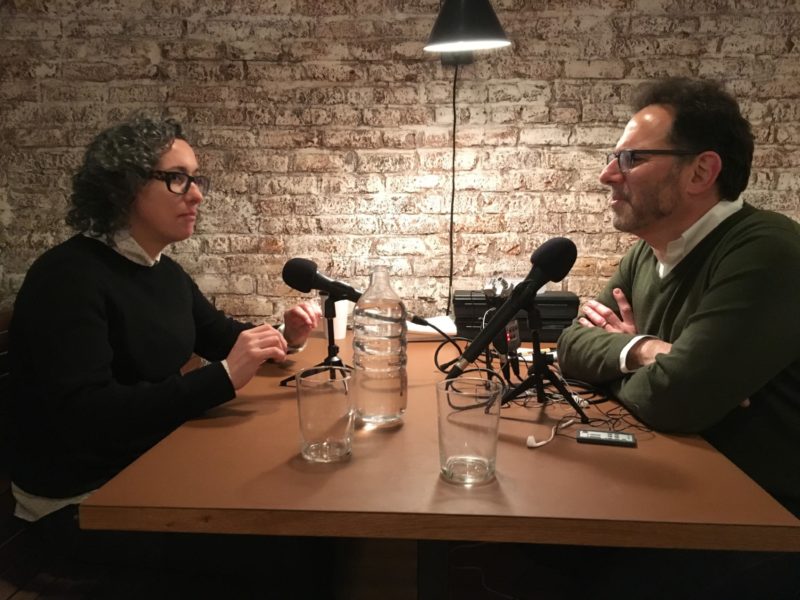
    When I re-booted this blog back in January, one of the things I had it in my mind to do was to meet up with fellow scribes and talk about what we do and how we see things in the chef world.  For my long-delayed first rap session, I selected Charlotte Druckman, who I’d never met, but had read and admired, and had always heard nice things about. In addition to writing for the Wall Street JournalTravel + Leisure, and myriad other publications Charlotte also collaborated on Anita Lo’s cookbook Cooking Without Borders.

    The reason I picked Charlotte to kick off this new, occasional feature: her first nonfiction book, Skirt Steak: Women Chefs on Standing the Heat and Staying in the Kitchen–for which she  interviewed more than 70 of the best female toques in the business–officially debuts this week. This is a topic I’ve long had an interest in, having discussed it with a number of chefs myself, and having noticed the almost total absence of women competitors in the Bocuse d’Or competition when I covered it a few years back.

    Charlotte and I had a long conversation, the highlights of which I’m sharing in two posts. Herewith, Part 1:

    Skirt Steak author Charlotte Druckman (photo courtesy Charlotte Druckman)

    TOQUELAND: Why food writing?

    DRUCKMAN: Why did I choose it as my linchpin? I say this in the introduction of my book: For me food is the sugar that helps the medicine go down. You can talk, especially now, about politics, agriculture, economics. You can talk about, if you want, gender. And you can talk about any of that stuff using food because it’s become the fixation point for the country, high and low.

    You can finally talk about things like hunger and the fact that it’s a problem because, thank God, Jamie Oliver is doing a prime time show on it. But for such a long time, you couldn’t do that. So I think if you love food, you already had that interest anyway. You’re interested in the people making it. But now I just think it’s cracked wide open. So I think writers should think about it possibly in a different way than food writers, right?

    TOQUELAND: It’s funny, I saw Josh Ozersky recently and he asked me if I liked being called a food writer. And I kind of don’t. I always say I consider myself a “chef writer,” not a food writer, because that’s what I know more than anything else—-the people and the life. I don’t know why, but it’s become almost like a literary ghetto a little bit in that non-food writers sometimes don’t give it equal respect.

    DRUCKMAN: Those ghostwriter stories in the spring solidified it for me by positing the whole question of ghost recipe testing versus ghost writing.  Because I am full-on a writer. I like to test recipes when I do my Wall Street Journal stuff, but I am by no means professionally trained to be a recipe tester.

    And, if you think about when you’re writing a cookbook, it’s left brain/right brain. The person who’s working on it–if it is a book that is really personality-shaped, the kind of work that you have to do to give it a point of view and organize it and then capture that voice is very different than what’s going into writing a recipe and making sure that the recipe’s okay. They’re two entirely different things.

    So again, when you say “food writer,” what do you mean? Are you writing recipes? Are you coming up with recipes? Or are you sitting down and writing about maybe the culture of food, or the person behind the food?

    So yeah, I think it’s easier to say, “I’m a journalist who writes about food” .. . [but] now I just say “food writer” because people seem to get confused or bored if you go into it too much.

    TOQUELAND: Do people assume you’re a critic when you tell them you’re a food writer? Expand

    Guest Poster David Mahler Shares the Story of Getting a Book Done .. . the Hard Way

    [Editor's Note: I've struck up several e-pan-pal relationships with chefs around the country since re-launching Toqueland in January. One I've especially enjoyed corresponding with is David Mahler, who recently succeeded in the daunting task of self-publishing his book, Cooking At La Cusinga with the Chef of the Jungle. I invited Dave to share a little about what it took to persevere on the less-taken road to book-dom, and his reflections are published below. If you want to check out his book, it can be ordered through Amazon.com in a paperback edition or as a download for Kindle, and is also downloadable from Google Books. A quality signed paperback edition is available directly from David by sending a check for $24 to David L Mahler; PO Box 397; Scotts Mills, OR  97375, or by paying directly through PayPal to chefofthejungle@yahoo.com.* You can find Chef Dave's own musings on food, life and cooking at www.chefofthejungle.blogspot.com. - A.F.]

    Chef David Mahler's Labor of Love (photo courtesy David Mahler)

    I am a chef. And I am the author of a cookbook, a real live cookbook (Cooking at La Cusinga with Chef of the Jungle, available on Amazon and Google). Finally. It sounds easy, doesn’t it? Lots of chefs write cookbooks, and lots of people who are not chefs write cookbooks. How hard can it be to write down some recipes, especially if you create them every day? As it turns out, the writing is the easy part, but self-publishing a finished, beautiful, heft-it-in-your-hand-and-drool-over-the-photos cookbook took a lot more steps than I knew existed.

    The writing and publishing spanned two countries and two years. Working at eco-lodge La Cusinga on the Pacific coast of Costa Rica, new recipes tripped over one another as I discovered the underutilized bounty of amazing ingredients available. Shrimp, mangos, ayote, mandarinas, hearts of palm, artisanal goat cheese—these ingredients don’t show up in the faux French restaurants that tourists flock to, and the locals stick to beans and rice. I got to know the owners of tiny organic farms and bought fish right off the boats. The lodge was full of guests and rare was the day when I wasn’t asked for a recipe for one my “fabulous” fresh tasting dishes. “You should have a cookbook, why don’t you have a cookbook?” I heard it so often I started to believe it. My boss offered his backing, and we were off and running.

    It took about 250 hours of writing and menu testing to get the recipes down on paper. The photos I took on the fly as we served the food. With a talented local artist working on the cover, we were getting closer to production. Until the vagaries of life stepped in, and I found myself moving to the Willamette Valley in Oregon to be with my fiancée, leaving the tropics behind but confident that I could find a small publishing house interested in “Chef of the Jungle”. After all, isn’t Costa Rica the darling of high-end vacationers in the U.S. and elsewhere? But I got a quick turndown in some cases and no response at all in others. “No one cares about Costa Rica” was the opinion of one publisher. I shelved the book. I sulked. I immersed myself in cooking.

    Fast forward six months. With strong encouragement (read kick in the pants) from my fiancée and family, I pulled the files back up and took a look. It wasn’t bad. It was better than I remembered. In fact, it was even pretty good. Good enough that I blithely thought, in this day and age of on-line wizardry, “I’ll just publish it myself.” Ha.

    It helps if you have a team. My sister, a professional indexer, edited and indexed it for me. (We all know how crucial a good index is to a cookbook; how many times have you cursed when you couldn’t find an entry for “chard” because it was under “Swiss”?) My brother-in-law worked on the cover. Together they formatted it and dropped the color photos into the right places. My younger sister did the copy editing, weeding out stray commas with a vengeance. They all, bless their hearts, made “suggestions.” Suggestions incorporated, final adjustments to color, indexing, and table of contents made, photos in place and text formatted, it was starting to look like a book.

    A shrimp dish from Cooking at La Cuisinga (photo courtesy David Mahler)

    But there are more steps than that. A book has to be copyrighted. It has to have a barcode. It has to have an ISBN number, two in fact—one for the hard copy and one for the .pdf version. Check, check, check. It was ready to sell.

    Sell, yes, but how? So many people had told me that it was incredibly simple, a piece of cake (no pun intended) to create an ebook through Google or Amazon. Uh huh, right. That would be for those of you that are versed in the intricacies of .pdf and jpeg files, of royalty and pricing platforms. I floundered in the minutiae of Google’s instructions. I did manage, after several false starts, to get the book into a Kindle format using Amazon’s KDM program. Still working with Amazon I dug into their Create Space program to turn the book into a “print on demand” paperback. Create Space reported the book ready to print and sent me a proof (not free). Some issues remain, but with Create Space you can fix things as you go.

    Some of us are still adherents to real books, made with paper and with pages you can turn, and I wanted printed copies that I could sign and sell, that you could prop up in your recipe holder or give to your aunt for Christmas. I needed a small, high-quality printer that would do a run of 100 books or less, all that my budget would stand. On a lead from an old Mennonite bookbinder practically in my own backyard, I found a small printer, Gorham Printing, up in the tiny town of Centralia, Washington. The price was right, and off went the .pdf files. Now I had both digital and hard-copy books I could sell.

    The View from Chef Dave Mahler's Old Kitchen at La Cusinga (photo courtesy David Mahler)

    Ah, yes, sell. As in, marketing. Ugh. I turned to Facebook—mocked by many, but still a great way to reach people. A copy of my book cover posted, I sent it to every “friend” I could think of, and, by virtue of Facebook’s pervasiveness, to some I couldn’t think of as well. I pushed the ease and familiarity of buying it on Amazon. I pushed yesterday, I pushed the day before yesterday, and I pushed this morning. I wangled a full-page story in a Costa Rican newspaper, and put an ad in a coastal magazine. I’ve been lucky enough to have a good number of pre-orders, some Kindle downloads, and a handful of “print on demand” paperbacks. I got great help getting here from friends and family, but now it’s up to me. Sales, R&D, bookkeeping, inventory control, and tech support. And, oh yeah, I’m also the author of a cookbook. And a chef.

    David Mahler

    * Toqueland takes no responsibility for fulfillment/delivery, but we’re required to say that. Make no mistake: We encourage our readers to support Chef Dave, and any chefs/writers brave enough to put it all out there like he has, by buying their books and visiting their blogs.

    An Upcoming Two-Part Class at the Institute of Culinary Education in New York City Takes a Look at All Aspects of Selling, Writing, and Publishing a Cookbook

    There are still some seats available for a two-part class I’m co-teaching at the Institute of Culinary Education in New York City next week. The class, Developing a Cookbook from Conception to Publication, will take place on two consecutive Wednesday nights, October 3 and October 10. I’ll be joined on the dais by my agent, David Black, and Pam Cannon, executive editor of Ballantine Books, a division of Random House; among other projects, Pam is editing my forthcoming cookbook collaboration with Michael White.

    David, Pam, and I will examine all aspects of the cookbook process, from ideation and proposal-writing to the pitch/sell to the writing, editing, and marketing/publication.

    In addition to whatever wisdom I have to offer, this is a rare chance to hear from some of the top people in the publishing game. If you are a writer or aspiring writer who might be interested, you can register here. If you know somebody who has cookbook aspirations, I’d appreciate if you passed this along.

    - Andrew

    Published in Appearances, Writing Life
Page 1 of 1012345...10...Last »